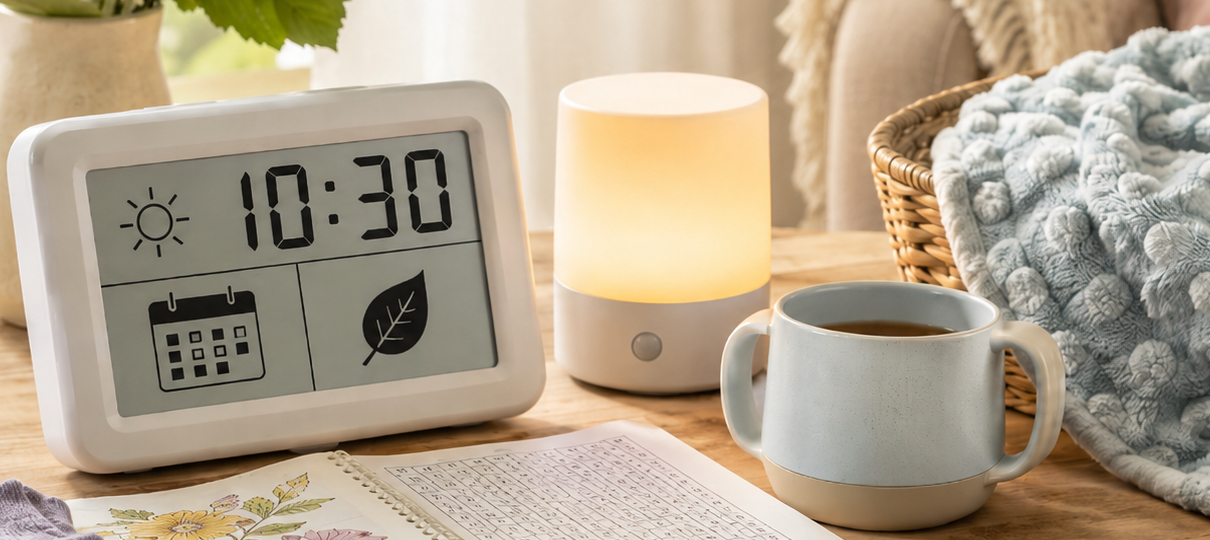
Before we bought a dementia clock, the same questions came up many times during the day.
What day is it?
Is it morning or evening?
Have I missed lunch?
Should I be getting ready for bed?
A regular clock showed the time, but it did not always give enough context. From personal experience, I can say that a dementia clock became one of the simplest and most useful tools in our home.
It did not solve every difficulty, but it gave us a clear and gentle point of reference.
Affiliate disclosure: This post contains affiliate links. If you purchase through one of these links, I may earn a small commission at no extra cost to you. As an Amazon Associate I earn from qualifying purchases.
What is a dementia clock?
A dementia clock, sometimes called a day clock or memory clock, displays more information than an ordinary clock.
Most models show:
- the current time;
- the full day of the week;
- the date;
- whether it is morning, afternoon, evening, or night.
Some also include simple reminders for meals, medication, appointments, or bedtime.
The main benefit is that all the information appears clearly in one place. A display such as:
Monday, July 20 — Morning — 9:15 AM
may be easier to understand than numbers alone.
How it helped us
For us, the greatest benefit was reassurance.
When there was uncertainty about the day or time, we could look at the clock together. Instead of repeatedly correcting or explaining, I could simply say:
“Let’s check the clock.”
This felt gentler and less frustrating for everyone.
The clock did not stop every repeated question, but it often helped. It became a familiar visual cue and allowed the person to check the information independently in some situations.
Even small moments of independence can matter.
See an example of a clear dementia-friendly day clock on Amazon
Why a regular clock may not be enough
A clock showing only “8:00” can still leave several questions.
Is it morning or evening?
Have we already eaten?
Is it time to get dressed or go to bed?
A dementia clock adds the missing context by showing the full day, date, and part of the day in words.
In our experience, the words morning, afternoon, evening, and night were especially useful.
What to look for when choosing one
I would look for a clock with:
- a large, high-contrast display;
- the full day and date written clearly;
- morning, afternoon, evening, and night shown in words;
- adjustable brightness;
- simple setup and controls.
Some models include alarms, spoken reminders, or a remote control. These can be helpful, but more features are not always better. A clear and uncluttered display may be easier to understand.
Before buying, check the screen size, language options, brightness settings, and what happens after a power cut.
Check the current details and price of this dementia clock on Amazon
Where to place it
Place the clock somewhere the person naturally looks during the day, such as near the television, beside their usual chair, on a bedroom dresser, or in the dining area.
Avoid placing it among too many photographs or decorations, and make sure there is no strong glare on the screen.
Once the person becomes familiar with its location, try not to move it unnecessarily.
Final thoughts
Looking back, the dementia clock was one of the simplest tools we introduced, but also one of the most worthwhile.
It gave us a shared point of reference. Sometimes it answered a question independently. At other times, it allowed us to find the answer together.
Most importantly, it provided information without impatience and without making anyone feel tested.
Based on my own experience, I believe a clear dementia clock is worth considering for families supporting someone who is becoming uncertain about the time, day, or daily routine.
It will not solve every difficulty, but a little more clarity can make an ordinary moment feel safer and calmer.