Tag: caregiver

  • Dementia Bathing Routine: A Calmer Way Through Shower Time

    Dementia Bathing Routine: A Calmer Way Through Shower Time

    Bathing can be one of the toughest parts of care—especially with dementia. Even when we’re gentle, the situation can feel confusing, exposing, or simply “too much.” I’ve seen it many times: a person who is calm all morning suddenly becomes tense, angry, or even aggressive the moment the bathroom routine begins.

    A dementia bathing routine can feel easier when shower time is approached slowly, gently, and with as much choice and dignity as possible.

    If that’s your reality, you’re not doing anything wrong.
    And your loved one isn’t “being difficult” on purpose.

    Often, what we’re seeing is stress + loss of control showing up in the only way the body knows how.

    One of the most helpful shifts is this:

    Instead of “I’m doing this to you,” we aim for “We’re doing this together.”

    Why involvement changes everything

    When someone feels powerless, their nervous system goes into دفاع mode (fight/flight).
    But when we give them a role—something meaningful to hold, do, or decide—bath time can become less like a “procedure” and more like a shared routine.

    Even small choices can restore dignity:

    • “Do you want the blue towel or the white one?”
    • “Would you like to wash your face first, or your hands?”
    • “Can you hold this for me?”

    The “Give Them a Job” approach (simple, practical, powerful)

    If bathing is triggering agitation, try offering a task right away—before tension escalates.

    Here are a few tried-and-true options:

    • A wash mitt / washcloth
      “Could you help by washing your hands?” or “Would you like to wash your face?”
    • A toothbrush (even if you’ll finish the job later)
      “Let’s do a quick brush while the water warms up.”
    • A small towel
      “Can you hold this and tell me if it feels too cold?”
    • A lotion bottle (cap loosened if needed)
      “Can you put a little on your arms while I get the towel ready?”
    • A comb or hairbrush
      “While we’re here, could you brush a little? I’ll do the back after.”
    • A “special” item that signals routine (a familiar soap, a favorite scent, a soft sponge)
      Familiar objects can cue safety.

    The goal isn’t perfect hygiene in one go.
    The goal is cooperation and calm—and then you build from there.

    Make it feel less like the bathroom “event”

    A few small things that can reduce overwhelm:

    • Warm the room first (cold air can spike distress fast)
    • Explain one step at a time (not the whole plan)
    • Use calm, predictable phrases (same words, same order—routine helps)
    • Cover what you’re not washing (a towel over lap/shoulders = instant dignity)
    • Move slowly and stay neutral
      If you look rushed, the body reads danger.

    If agitation rises: a gentle pivot

    Sometimes the best care is knowing when to pause.

    If you see signs like clenched hands, raised voice, pulling away, “no no no,” try:

    • Step back half a pace
    • Lower your voice
    • Offer the “job” again (something to hold/do)
    • Switch to an easier area (hands/face)
    • Or call it a win for now and try later

    You can always come back.
    You’re playing the long game: safety, trust, dignity.

    A calmer dementia bathing routine may begin with small changes, such as warming the room, preparing towels ahead of time, and explaining each step in a soft voice.

    After the storm: what helps next

    When the bathing moment finally settles, many people still carry leftover stress in their body. That’s where a soft, familiar activity can help them re-ground.

    If you’d like an easy way to set that up, you might enjoy this post:

    A simple “cozy basket” (something to hold, fold, sort, or flip through) can be a lovely bridge back to calm—especially after a hard-care moment.

  • Gentle Conversation Starters for Seniors: Small Questions, Big Connection

    Gentle Conversation Starters for Seniors: Small Questions, Big Connection

    A calm, low-pressure way to spark meaningful conversations with seniors—especially on days when “How are you?” doesn’t go anywhere.

    There’s a special kind of quiet that can happen during family visits.

    You finally sit down together. Tea is poured. Everyone is “fine.”
    And then… the conversation stalls.

    Not because you don’t care.
    Not because there’s nothing to say.
    But because sometimes the usual questions—“How are you?” “How was your day?”—feel too big, too vague, or just… too tired.

    That’s why I love gentle conversation starters.

    They’re small, friendly questions that don’t demand perfect memory or deep emotional energy—but still invite connection. And very often, they open the door to something beautiful: laughter, a story you’ve never heard, or a moment that feels like “Oh, there you are.”


    Why conversation matters (especially with seniors)

    Meaningful conversation isn’t just “nice to have.” It can be grounding.

    For many seniors (and for many families), conversation helps with:

    • Feeling seen and included (not just “taken care of”)
    • Reducing loneliness through simple daily connection
    • Gentle memory stimulation—without turning it into a test
    • Strengthening family bonds across generations
    • Creating calm structure during visits, phone calls, or caregiving routines

    And for caregivers?
    Having a few ready-to-go prompts can ease the pressure of feeling like you have to perform conversation.


    A helpful mindset: don’t chase “perfect memory”

    A quick note that can change everything:

    You don’t need exact dates, names, or details for a conversation to be meaningful.

    Sometimes the goal isn’t accuracy.
    It’s comfort, connection, and emotional safety.

    If a question doesn’t land, just let it float by and try another. If a story repeats, you can treat it like a favorite song—familiar, comforting, worth hearing again.


    12 gentle conversation starters you can use today

    Here are a few low-pressure prompts that work well for seniors (and honestly, for anyone):

    1. What’s something small that made you smile recently?
    2. What’s a cozy meal you’ve always loved?
    3. If you could spend a day anywhere you’ve been before, where would you go?
    4. What’s something you were really good at when you were younger?
    5. What did a “perfect weekend” look like when you were in your 20s?
    6. What’s a song that still feels like a good memory?
    7. Did you have a favorite teacher—or a subject you liked?
    8. What’s one thing you’ve learned about people over the years?
    9. What’s a smell that brings you back to a specific place?
    10. What’s something you used to do for fun that people don’t do as much now?
    11. What’s a small tradition you remember from your family?
    12. What’s one thing you’d tell your younger self (gently)?

    If you want to keep it extra easy: pick one question and let it be enough.


    How to use prompts without it feeling awkward

    A few simple tips that make conversation starters feel natural:

    • Ask while doing something else (tea, a walk, folding laundry). Side-by-side conversation often flows easier than face-to-face.
    • Follow the energy—if something lights them up, stay there.
    • Offer choices (“Would you rather talk about childhood, work, or travel?”)
    • Keep it short: one good question can carry 15 minutes.
    • End on a warm note: “I loved hearing that.” / “That’s such a good story.”

    When memory is sensitive (dementia-friendly approach)

    If memory is a tender area, you can still have beautiful conversations—just keep prompts:

    • sensory (smells, songs, foods, seasons)
    • emotion-based (what felt comforting, what felt joyful)
    • present-focused (what feels good today)

    And if a question causes frustration, simply pivot:
    “Let’s skip that one—tell me what you’d pick for dessert instead.”

    No pressure. No correction. Just kindness.


    A gentle resource (if you want prompts ready-to-go)

    If you’d like a calm, structured set of prompts you can print and keep nearby, I created a Large Print “Gentle Conversation Starters” workbook—designed for seniors, caregivers, and family visits.

    It includes:

    • 60 gentle prompts
    • large-print pages
    • bonus sections for follow-ups, favorites, and “how to use”
    • A4 + US Letter formats

    If that sounds helpful, you can find it here in my Etsy shop:
    👉

    No pressure—just a gentle tool for the days you want connection without the mental load.

    You don’t need a big conversation to have a meaningful moment.

    Sometimes all it takes is one small question asked with warmth.
    And then you get a story. A laugh. A soft “remember when.”
    A little more togetherness than you had five minutes ago.

    That counts. 💛

  • A Gentle Way to Spend Time Together: Word Searches for Seniors (and the Stories They Unlock)

    A Gentle Way to Spend Time Together: Word Searches for Seniors (and the Stories They Unlock)

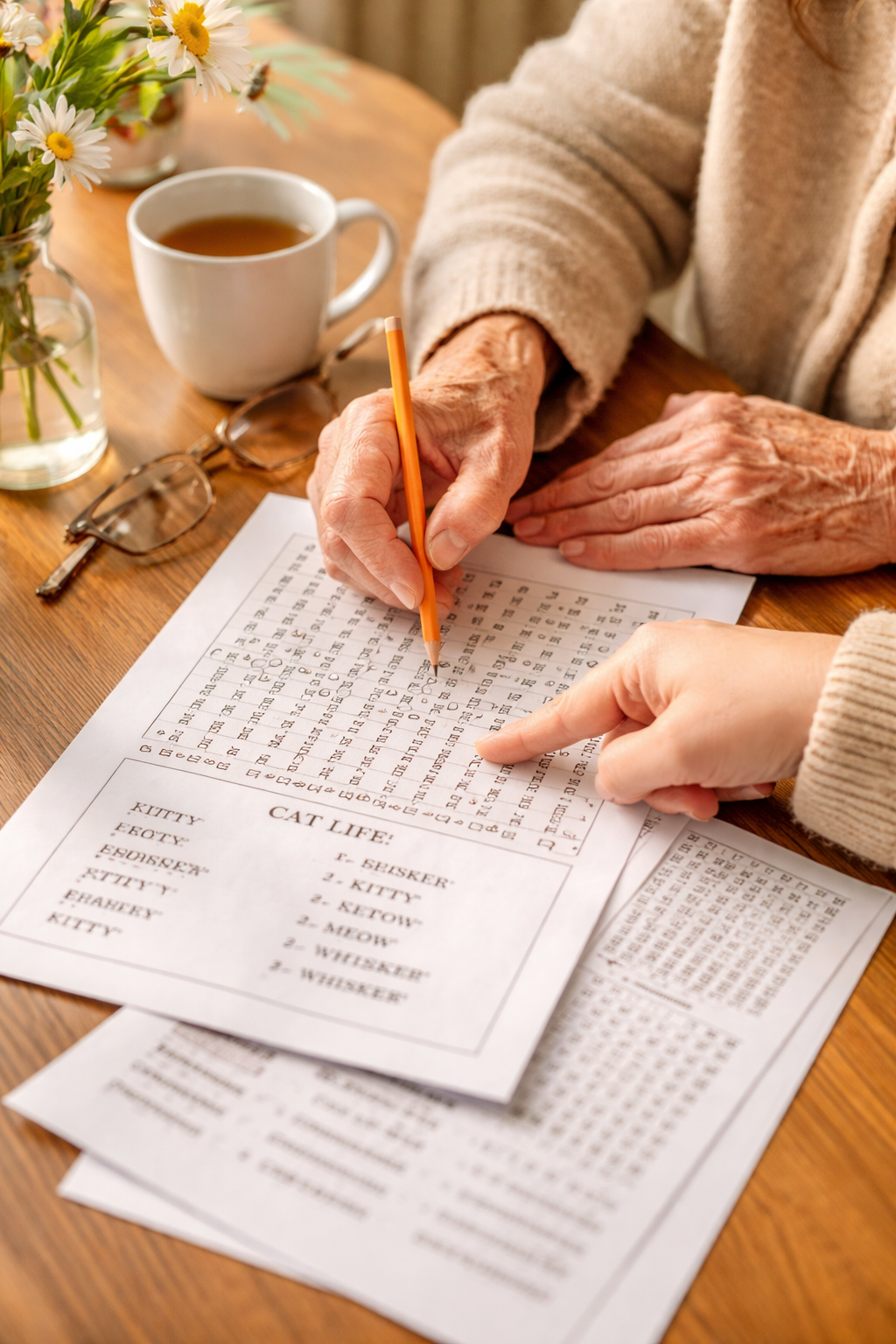
    Word searches for seniors can be more than a simple activity. For caregivers and loved ones, they can become a gentle way to sit together, share a quiet moment, and make the day feel a little calmer.

    There’s a certain kind of quiet that caregivers know well.

    Not the empty kind — the attentive, caring kind that happens when you’re sitting beside someone you love, sharing a moment that doesn’t ask too much. A cup of tea. A pencil. A page that feels simple and safe.

    This is personal for me. I’m a caregiver in more than one way — within my family and through my work. I’ve seen how quickly a day can feel heavy when we’re trying to “fill time” without over-stimulating, confusing, or tiring the person we’re caring for.

    And I’ve also seen how one gentle activity can change the mood of an entire afternoon: less pressure, more connection.

    That’s why I keep creating senior-friendly activities — not because we need to “fix” anyone, but because we all deserve moments that feel calm, dignified, and shared.


    Why word searches can be such a comforting activity

    Word searches are wonderfully low-pressure. There’s no timer, no right way to do it, and no need to “perform.” It’s simply looking for familiar words and letting the brain settle into a gentle rhythm.

    For many seniors — including those experiencing memory changes — word searches can offer:

    • A sense of success (finding even one word is a win)
    • A calming focus (the mind has something simple to do)
    • A small spark of memory (familiar words can unlock stories)
    • A shared moment (you can do it together without it feeling like “therapy”)

    Sometimes the best part is not the puzzle itself, but what happens while you’re doing it: a laugh, a remembered pet name, a “Oh! I see it!” moment.


    A free 3-page printable to try together

    To make it easy to start, I created a small freebie you can download and print today:

    Free Printable: 1 Word Search Puzzle + Word List + Answer Key (3 pages)

    • Large print
    • Very easy
    • Senior-friendly layout
    • Perfect for a short, gentle activity session

    How to use it (no pressure, just connection):

    • Sit side-by-side and find the first word together
    • Take breaks whenever needed
    • Celebrate tiny wins (“You found it!” goes a long way)
    • If a word brings a memory, follow it gently — and if not, that’s okay too

    Tip: If the person you’re with tires easily, even 5–10 minutes can be “enough.” The goal isn’t finishing — it’s sharing time.


    Turning a worksheet into a small connection ritual

    A few simple ways to make this feel warm and meaningful:

    1. Do it with them, not for them
      “Shall we look for the first one together?”
    2. Invite stories without pushing
      If the theme is animals & pets, you can ask softly:
      “Did you ever have a pet like that?”
      If it doesn’t land, just move on.
    3. Keep the pace slow
      This is not about completing the page. It’s about a calm moment.
    4. Make it cozy
      Tea, soft light, quiet background music — the environment matters.

    If you’d like more: the full Animals & Pets set

    If the freebie feels like a good fit, I also made a full Animals & Pets Word Search set for seniors, designed in the same gentle style — large print, very easy, and caregiver-friendly.

    Full Version includes (60 pages total):

    • 20 word search puzzles
    • 20 matching word lists
    • 20 answer keys (solutions included)
    • Printable PDF in A4 + US Letter

    👉 See the full Animals & Pets Word Search set here:


    A soft reminder for caregivers

    You don’t need a “perfect” activity. You just need something that makes it easier to be together without pressure.

    Sometimes it’s a pencil, a page, and the quiet joy of finding a simple word side by side.


    Please note: This is a digital download. No physical item will be shipped.