Category: Caregiver Corner

Caregiver Corner is a gentle little space for real-life caregiving — simple routines, calm activities, and printable resources for quiet moments and connection. Practical, human, and sometimes a bit funny.

  • Why Colors Matter in Dementia Care: Gentle Shades That Can Support Calm, Comfort, and Connection

    Why Colors Matter in Dementia Care: Gentle Shades That Can Support Calm, Comfort, and Connection

    When someone is living with dementia, the world can sometimes feel more confusing, overwhelming, or tiring than it used to.

    In moments like these, small things in the environment can matter more than we expect — and color is one of those small things.

    The colors in a room, on a curtain, on a blanket, on a tablecloth, or even on a simple activity page can shape how a space feels: calm or busy, comforting or distracting, easy to rest in or harder to settle into.

    There is no single “perfect” color palette for every person. But gentle, thoughtful color choices can help create a more supportive atmosphere for quiet time, everyday routines, and visits together.

    In this post, I’m sharing a few simple ideas for using color in a more dementia-friendly way — in a home, a care setting, or anywhere you want to create a calmer feeling.

    1. Why color can feel especially important in dementia care

    Dementia can affect the way a person processes information, including visual information. A room that feels normal to one person may feel too busy, too bright, or difficult to read to someone else.

    That’s one reason color can matter in daily life.

    Gentle color choices may help:

    • a room feel calmer
    • reduce visual stress
    • make some everyday items easier to notice
    • support comfort during visits or quiet activities

    Color is not a cure, of course — but it can be one small, meaningful part of a more supportive environment.


    2. Gentle, calming colors that often feel easier to live with

    Many caregivers notice that soft, muted colors feel easier during stressful or tiring days.

    Some often-comforting choices include:

    • soft blues
    • muted greens
    • warm neutrals (cream, beige, soft taupe)
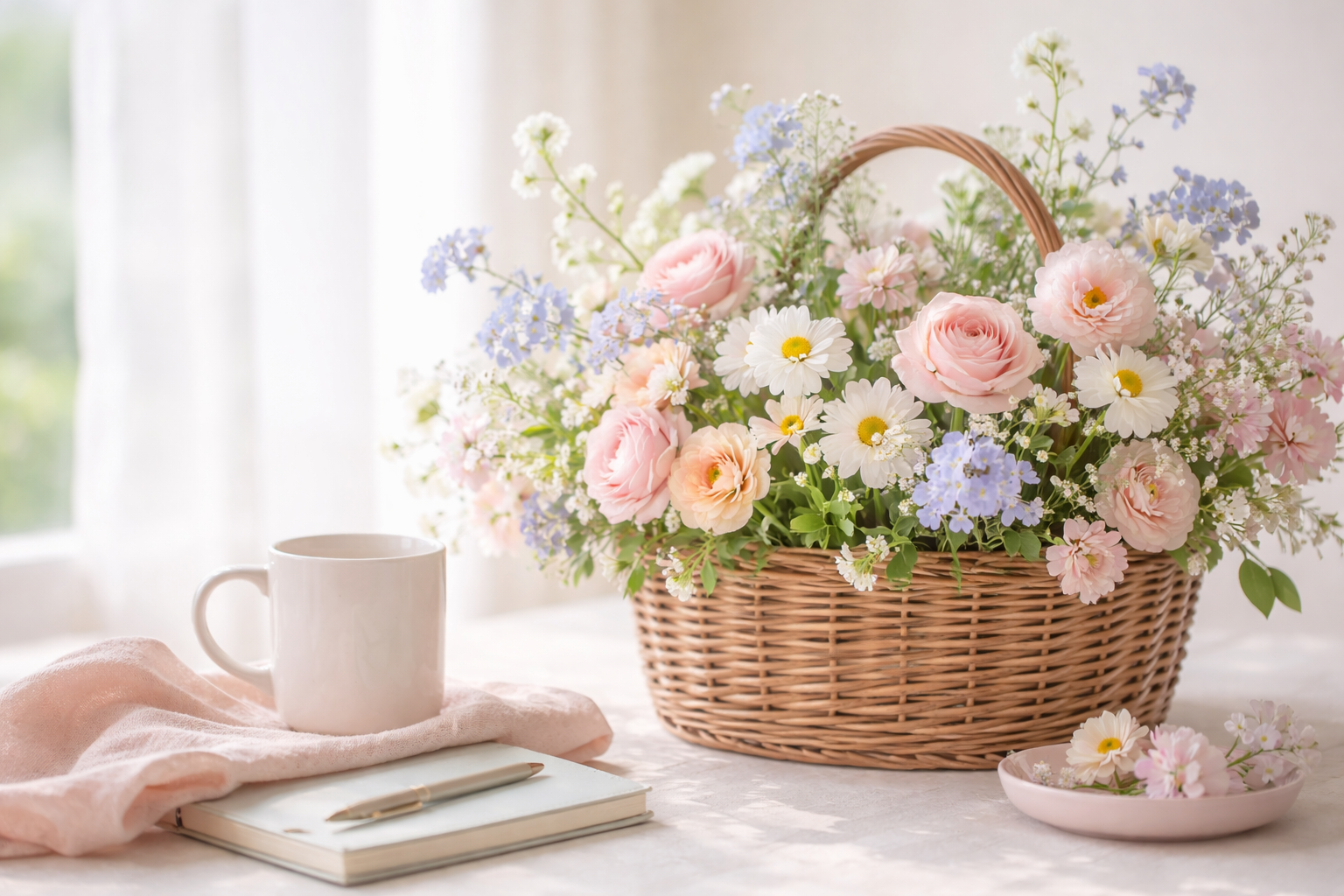
    • dusty rose / soft blush
    • gentle lavender
    • warm light gray (not too cool)

    These kinds of shades can make a space feel:

    • less visually “loud”
    • more restful
    • easier to stay in for longer periods
    • comforting during quiet moments

    A gentle reminder: familiarity matters too

    What feels calming is very personal.

    For one person, a warm peach tone may feel comforting because it reminds them of a familiar room or a favorite blanket. For someone else, soft blue may feel more peaceful.

    In dementia care, familiar and comforting often matters more than “perfect design.”


    3. Colors and patterns that may feel overwhelming in some spaces

    This doesn’t mean bright colors are bad. Bright colors can be joyful, meaningful, and helpful in the right place.

    But in spaces meant for rest or calm, too much visual intensity can sometimes feel overstimulating.

    It may help to use less of:

    • harsh, high-contrast color combinations
    • neon tones
    • very busy multicolor patterns
    • shiny or reflective surfaces that create visual “noise”

    If a room already feels a little busy, even one small change — like a calmer curtain, a plain blanket, or a less patterned tablecloth — can sometimes make a noticeable difference.


    4. Easy ways to bring in calming color (without redecorating everything)

    You don’t need to redo an entire room.

    Small changes can still help create a gentler atmosphere.

    Simple places to start

    • blankets or throws
    • cushion covers
    • curtains
    • bed linens
    • placemats or tablecloths
    • favorite mugs or cups
    • storage baskets
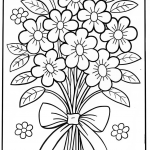
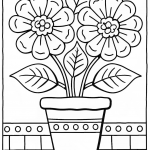
    • printable activities and coloring pages

    A more consistent, gentle palette in everyday items can make a space feel less visually tiring — and often more comforting.

    5. Color can also support connection during visits

    Color is not only about decoration. It can also support emotional comfort and connection.

    For example:

    • a familiar floral pattern in soft colors may spark a memory
    • a favorite colored mug may feel grounding
    • a gentle coloring page may make it easier to spend quiet time together
    • a calm visual setting can make visits feel less pressured

    Sometimes conversation flows. Sometimes it doesn’t.

    A calm activity and a calmer environment can help make “being together” feel easier, even when words are hard.


    6. Gentle coloring pages as a calm, low-pressure activity

    Coloring is not just for children. For many seniors (including people living with dementia), simple coloring pages can offer:

    • a gentle focus
    • a quiet rhythm
    • less pressure than conversation
    • a shared activity during visits

    What often helps most:

    • large-print / large shapes
    • simple designs
    • clear outlines
    • less clutter on the page
    • no pressure to finish

    If you’d like a gentle place to start, I have a few free printable options in my freebies library:

    👉 Browse the Freebies Library

    And if you’re looking for more printable coloring pages in the same calm, simple style, I also make a few senior-friendly options in my Etsy shop:

    (These are designed to be simple, gentle, and easy to use for quiet moments — not perfect results.)

    7. A gentle way to test what feels best

    If you’re not sure which colors feel most comfortable, try a simple “one small change” approach:

    1. Change one small thing (for example, a blanket, cushion cover, or activity page)
    2. Notice how the room feels for a few days
    3. Keep what feels calmer, easier, or more comforting

    No pressure. No perfect palette needed.

    In dementia care, the goal is not perfection — it’s comfort, support, and connection.


    Final thoughts

    The colors around us can’t remove every hard moment, but they can shape the feeling of a room.

    And sometimes, a calmer room helps create a calmer moment.

    Small, simple supports matter.

    If you’re a caregiver, family member, or activity coordinator, I hope this gives you one or two gentle ideas to try. You don’t need to change everything at once — even small shifts can help.

  • The 5-Minute Midlife Check-In: A Gentle Routine for Caregivers in “Menopause Season”

    The 5-Minute Midlife Check-In: A Gentle Routine for Caregivers in “Menopause Season”

    There are seasons of caregiving when you’re running on love… and fumes.
    And then there are seasons when your own body decides to add a few surprises too—sleep changes, energy dips, mood swings, or that strange “why do I feel off today?” feeling.

    If you’re in that midlife changes / “menopause season” chapter, I just want to say this upfront:

    You don’t need a perfect routine.
    You don’t need to track everything.
    You don’t need to “fix” yourself.

    You only need a tiny, gentle way to notice patterns—so your days feel a little more predictable, a little more manageable, and a little more kind.

    Today I’m sharing a simple 5-minute check-in I love for caregivers. It’s calm, low-pressure, and realistic (even on the messy days).


    Why midlife changes can feel extra heavy when you’re a caregiver

    Caregiving already asks a lot:

    • planning and coordinating
    • emotional presence
    • decision fatigue
    • unpredictable days

    Midlife changes can add “invisible variables”:

    • sleep quality shifts
    • mood and anxiety spikes
    • energy crashes
    • changes in patience, focus, or overwhelm tolerance
    • physical symptoms that come and go

    So when you think, “Why is this so hard lately?” the answer is often:
    Because you’re carrying a lot, and your body is doing a lot too.

    This isn’t about labeling anything as “wrong.”
    It’s about creating a tiny bit of clarity.


    The goal: “soft tracking” (not a strict wellness routine)

    I call it soft tracking because:

    • it’s quick
    • it’s gentle
    • it doesn’t require perfection
    • it’s about noticing—not judging

    Think of it like turning on a small lamp in a dark room.
    You’re not renovating your whole life. You’re just trying to see what’s there.


    The 5-minute midlife check-in (caregiver-friendly version)

    1) Morning (2 minutes): “Where am I today?”

    Pick 3 quick ratings (no overthinking):

    • Sleep (1–5)
    • Energy (1–5)
    • Mood (1–5)

    Then add one sentence:

    • “Today I need: ________”
      Examples: quiet, fewer decisions, fresh air, a simple dinner, a slower pace.

    That’s it.

    2) Evening (3 minutes): “What did I notice?”

    Answer just two prompts:

    1) What felt hardest today?
    One short line. No essays.

    2) What helped—even a little?
    This can be tiny:

    • warm tea
    • a 10-minute sit-down
    • a short walk
    • a good laugh
    • a calmer conversation
    • a simple meal
    • a cozy activity
    • a “we made it through” moment

    I call these small comforts—and they matter more than we think.


    What to track (if you want it even simpler)

    If you only track one thing, track this:

    “What helped today?”

    Because that question quietly builds your personal toolkit—without pressure.

    If you want a little more structure, add:

    • sleep quality
    • energy
    • mood
    • one symptom (optional)

    Over time, patterns show up like:

    • “Bad sleep = everything feels louder.”
    • “Busy mornings = more overwhelm by afternoon.”
    • “A short walk helps more than I expect.”
    • “Certain weeks feel harder—and I can plan gentler dinners.”

    That’s not “fixing.”
    That’s understanding.


    How this helps caregiving (in real life)

    This tiny check-in can make caregiving smoother because:

    • you can plan around low-energy days
    • you can choose lower-pressure activities together
    • you can reduce decision fatigue (“we’ll do the easy option today”)
    • you can communicate more honestly with yourself—and sometimes with others

    And maybe most importantly:
    It reminds you that you’re a person too, not just the one who holds everything together.


    A gentle reminder (not medical advice)

    I’m not a medical professional, and this post isn’t medical advice.
    If symptoms feel intense, scary, or disruptive, it’s always okay to reach out for professional support. You deserve care, too.


    If you want a printable version of this check-in

    If you’d like a simple, ready-to-print tracker for mood, sleep, energy & symptoms—plus gentle reflection prompts—this is the one I made for myself (and then turned into a printable):

    It’s designed to be:

    • low-pressure
    • quick to fill out
    • easy to print at home
    • focused on “notice patterns + small comforts”

    (And yes—this can absolutely sit inside your Caregiver Corner life. Because caregivers need steady days too.)

    Want more gentle caregiver ideas?

    If today is a “keep it simple” day, you might also like:


    Closing

    Whatever today looks like: you’re doing a lot.
    A tiny check-in won’t solve everything—but it can make the day feel a little more held.

  • The Cozy Activity Basket: A Gentle Setup for Calm, Low-Stress Days (Seniors & Caregivers)

    The Cozy Activity Basket: A Gentle Setup for Calm, Low-Stress Days (Seniors & Caregivers)

    There are days when you want to spend time together… but you don’t have the energy to plan an “activity.”
    And sometimes the person you care for doesn’t either.

    That’s where a cozy activity basket helps.

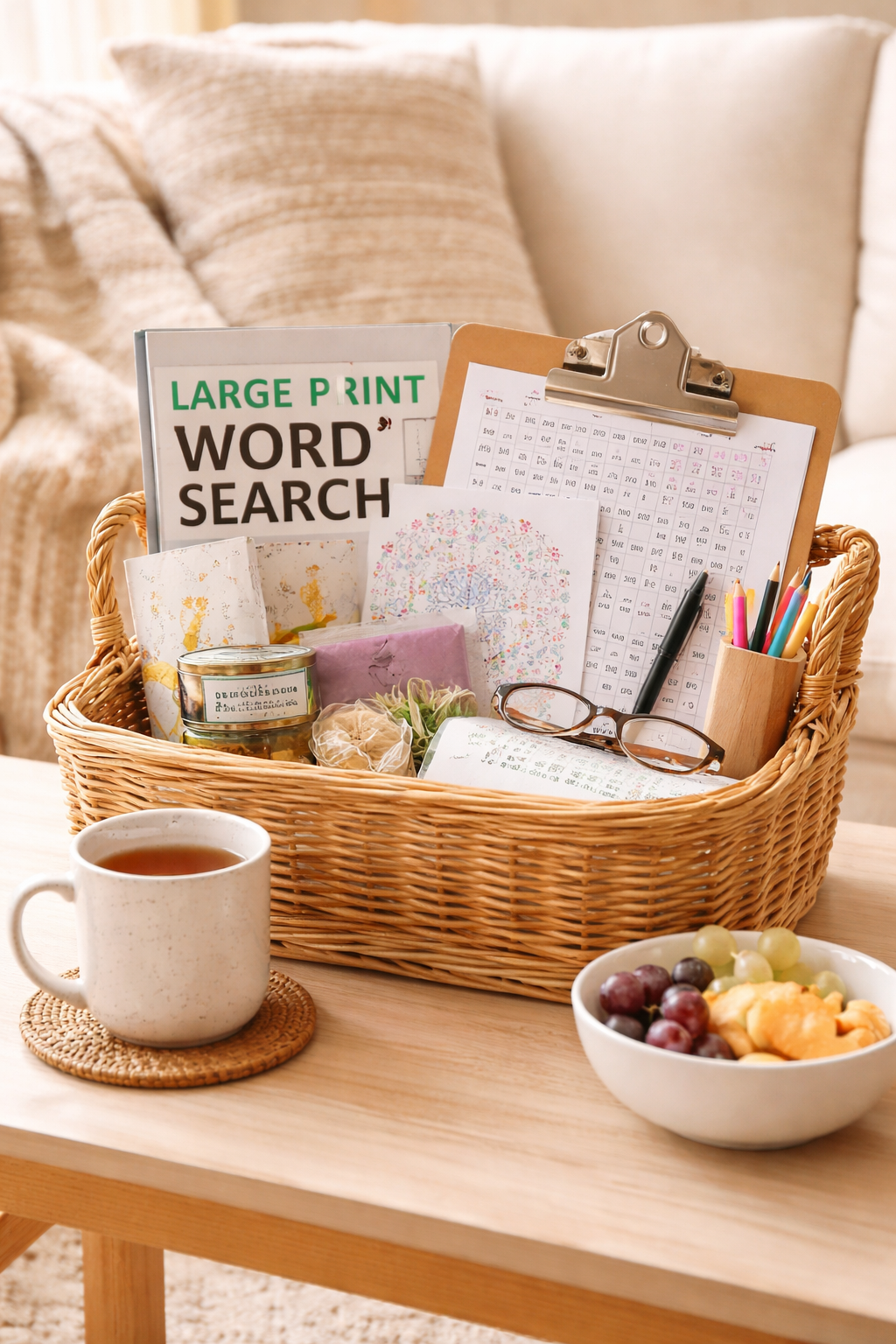
    It’s a simple, ready-to-grab set of comforting, low-pressure activities that makes visits smoother, reduces decision fatigue, and creates more “we’re okay” moments — even on tired days.

    In this post, I’ll show you exactly what to put in one (large-print friendly!), how to use it, and a few easy theme ideas you can rotate through the seasons.

    What is an “activity basket” (and why it works)

    An activity basket is just what it sounds like: a small basket (or tray, tote, folder — anything works) stocked with a few ready-to-go items.

    Why it works so well:

    • Less decision fatigue: no “What should we do?” spiral.
    • Gentle structure: activities are familiar and predictable.
    • Low-pressure connection: side-by-side time counts, even without big conversation.
    • Easy reset: you can pull it out for 10–20 minutes and feel like the day has a shape again.

    If you want an easy “starter activity” that reliably opens up memories and stories, word searches are surprisingly good for that.

    Anchor idea: “A Gentle Way to Spend Time Together: Word Searches for Seniors (and the Stories They Unlock)”


    What to put in a cozy activity basket (simple checklist)

    Think large print, low mess, low stress, familiar.

    The basics

    • Large-print word searches (with an answer key)
    • A large-print word list (if your puzzles use one)
    • Coloring pages (simple, bold lines)
    • A clipboard or hard writing surface
    • 2–3 pens or markers (dark ink; easy grip if possible)
    • Reading glasses (optional, if helpful)
    • A small pouch for finished pages

    Comfort extras (optional, but lovely)

    • A cozy tea bag or cocoa sachet
    • A small snack (soft, easy-to-eat)
    • A comforting scent (lavender sachet) only if tolerated
    • A soft timer (optional) to keep things “short and sweet”

    Pro tip: keep it small

    This works best when it’s not overwhelming. Start with 3 activity types only.


    Three ready-to-go basket themes (choose one to start)

    You don’t need a “perfect” basket. Pick one theme that matches your person’s mood and abilities.

    1) The Cozy Quiet Basket (for calm, low-stimulation days)

    Best for: tired afternoons, low energy, “quiet company”

    Include:

    • 2–4 coloring pages (large print, bold lines)
    • 1–2 gentle word searches
    • a mug + tea sachet (optional)

    How to use it:

    • Sit side-by-side
    • Put on soft music (or none)
    • Color for 5–10 minutes, then switch to a word search if they want

    If you’d like a couple of quick, printable pages to use immediately, you can find a small collection here:


    2) The Memory & Stories Basket (for connection without pressure)

    Best for: visits, family time, “I want to talk but don’t know how”

    Include:

    • A large-print word search (simple theme: pets, seasons, foods)
    • A short list of gentle prompts
    • A notepad (for writing down stories or names that come up)

    A helpful trick:
    Let the puzzle do the talking.
    Even one word (“dog,” “garden,” “valentine”) can trigger a memory.

    If conversation feels hard, these gentle prompts can help a lot.

    Anchor idea: “Gentle Conversation Starters for Seniors: Small Questions, Big Connection”


    3) The Kitchen Comfort Basket (for familiar routines)

    Best for: food memories, cozy chatting, “hands busy, mind calm”

    Include:

    • 2–3 large-print recipe cards
    • A simple “memory menu” prompt list
      (e.g., “favorite soup,” “Sunday dinner,” “first thing you learned to cook”)

    You can also pair this with a “tired day” dinner plan (so you’re not reinventing the wheel every week).

    Anchor idea: “Caregiver Corner: 10 Easy Large-Print Recipes for Gentle Kitchen Days”


    A 15-minute “reset routine” for tired days

    On hard days, you don’t need a big plan. You need a gentle reset.

    Try this simple routine:

    1. Set the scene (2 minutes)
      Bring the basket to the table. Put out one page only. Make it easy to start.
    2. Choose ONE thing (1 minute)
      You pick, kindly.
      “Want to do this one together?”
    3. Do it side-by-side (8–10 minutes)
      No pressure to finish. The goal is calm, not performance.
    4. End on a good note (2 minutes)
      “Let’s stop here — this was nice.”

    If you repeat this often, the basket becomes a cue for comfort and connection.


    Optional: a ready-made printable kit (if you want zero prep)

    If you like the idea of the activity basket but don’t want to assemble pages and themes every time, a ready-to-print set can be helpful.

    Optional: I keep a few large-print, senior-friendly printable bundles in my Etsy shop — designed for calm routines and gentle caregiver days.

    (If you prefer, you can also start by using the free printables first and see what your person enjoys most.)


    Tips to make activities more dementia-friendly (and less frustrating)

    Every person is different, but these tend to help:

    • Go larger: large print + bold lines reduce strain
    • Shorter is better: choose 5–10 minute activities
    • Offer choices carefully: “This or this?” (not 10 options)
    • Skip correction: it’s okay if the puzzle isn’t finished
    • Celebrate effort: “That was a good one.”

    If your loved one becomes irritated quickly, try coloring or sorting (very gentle) before word searches.


    Frequently asked questions

    “What if they don’t want to do anything?”

    That’s normal. Keep the basket visible but low-pressure.
    Sometimes the best entry point is:
    “Can you help me find just one word?”

    “What if their hands shake or grip is weak?”

    Use thicker pens/markers and a clipboard.
    You can also do “pointing” instead: you read the word, they point to the letters.

    “How many pages should I keep in the basket?”

    A small rotation is perfect:

    • 5–10 word searches
    • 6–10 coloring pages
    • a few recipe cards or prompts
      Refresh monthly or seasonally.

    A gentle next step

    If you want to make this easy, do this today:

    1. Pick a basket (or folder)
    2. Print two pages (one word search + one coloring page)
    3. Add a pen + clipboard
    4. Put it somewhere you can grab in 10 seconds

    That’s it. You’ve built a calm option for the next hard moment.

    ➡️ Freebies:


    ➡️ More Caregiver Corner posts:


    Disclosure

    This post may include links to free resources and/or my own printable products. Some posts on this site may also contain affiliate links, which means I may earn a small commission at no extra cost to you.

  • Gentle Conversation Starters for Seniors: Small Questions, Big Connection

    Gentle Conversation Starters for Seniors: Small Questions, Big Connection

    A calm, low-pressure way to spark meaningful conversations with seniors—especially on days when “How are you?” doesn’t go anywhere.

    There’s a special kind of quiet that can happen during family visits.

    You finally sit down together. Tea is poured. Everyone is “fine.”
    And then… the conversation stalls.

    Not because you don’t care.
    Not because there’s nothing to say.
    But because sometimes the usual questions—“How are you?” “How was your day?”—feel too big, too vague, or just… too tired.

    That’s why I love gentle conversation starters.

    They’re small, friendly questions that don’t demand perfect memory or deep emotional energy—but still invite connection. And very often, they open the door to something beautiful: laughter, a story you’ve never heard, or a moment that feels like “Oh, there you are.”


    Why conversation matters (especially with seniors)

    Meaningful conversation isn’t just “nice to have.” It can be grounding.

    For many seniors (and for many families), conversation helps with:

    • Feeling seen and included (not just “taken care of”)
    • Reducing loneliness through simple daily connection
    • Gentle memory stimulation—without turning it into a test
    • Strengthening family bonds across generations
    • Creating calm structure during visits, phone calls, or caregiving routines

    And for caregivers?
    Having a few ready-to-go prompts can ease the pressure of feeling like you have to perform conversation.


    A helpful mindset: don’t chase “perfect memory”

    A quick note that can change everything:

    You don’t need exact dates, names, or details for a conversation to be meaningful.

    Sometimes the goal isn’t accuracy.
    It’s comfort, connection, and emotional safety.

    If a question doesn’t land, just let it float by and try another. If a story repeats, you can treat it like a favorite song—familiar, comforting, worth hearing again.


    12 gentle conversation starters you can use today

    Here are a few low-pressure prompts that work well for seniors (and honestly, for anyone):

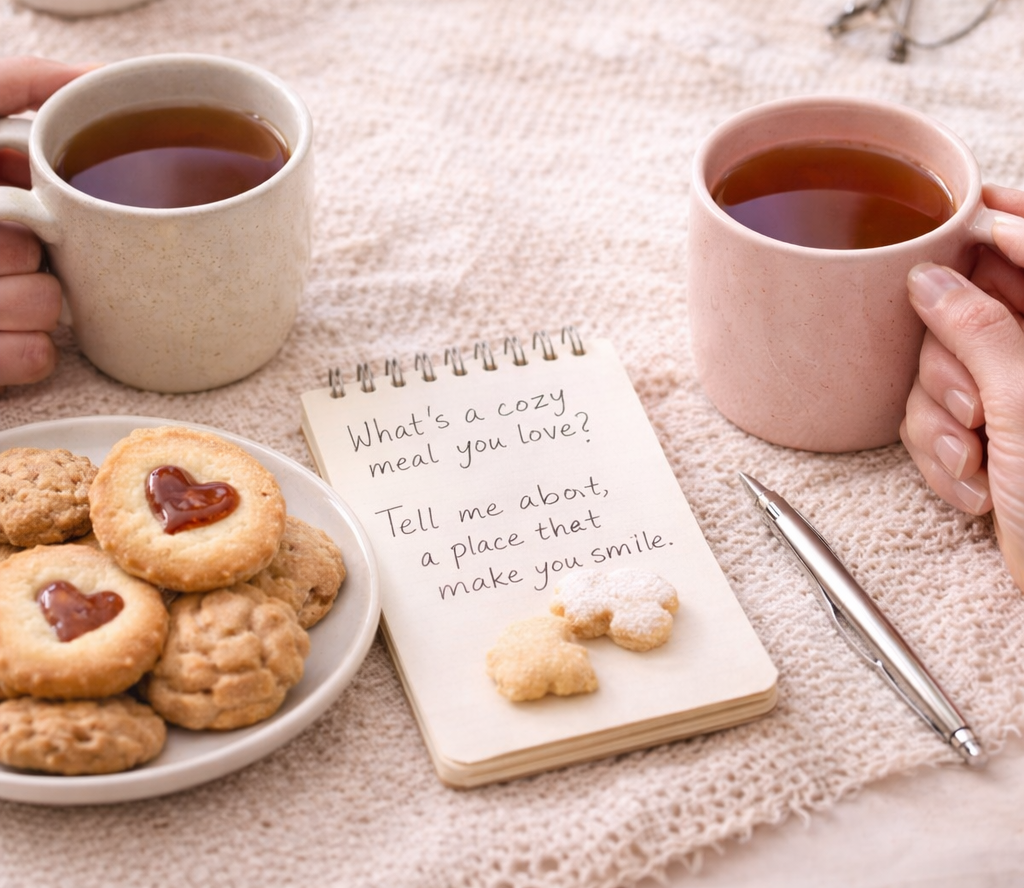
    1. What’s something small that made you smile recently?
    2. What’s a cozy meal you’ve always loved?
    3. If you could spend a day anywhere you’ve been before, where would you go?
    4. What’s something you were really good at when you were younger?
    5. What did a “perfect weekend” look like when you were in your 20s?
    6. What’s a song that still feels like a good memory?
    7. Did you have a favorite teacher—or a subject you liked?
    8. What’s one thing you’ve learned about people over the years?
    9. What’s a smell that brings you back to a specific place?
    10. What’s something you used to do for fun that people don’t do as much now?
    11. What’s a small tradition you remember from your family?
    12. What’s one thing you’d tell your younger self (gently)?

    If you want to keep it extra easy: pick one question and let it be enough.


    How to use prompts without it feeling awkward

    A few simple tips that make conversation starters feel natural:

    • Ask while doing something else (tea, a walk, folding laundry). Side-by-side conversation often flows easier than face-to-face.
    • Follow the energy—if something lights them up, stay there.
    • Offer choices (“Would you rather talk about childhood, work, or travel?”)
    • Keep it short: one good question can carry 15 minutes.
    • End on a warm note: “I loved hearing that.” / “That’s such a good story.”

    When memory is sensitive (dementia-friendly approach)

    If memory is a tender area, you can still have beautiful conversations—just keep prompts:

    • sensory (smells, songs, foods, seasons)
    • emotion-based (what felt comforting, what felt joyful)
    • present-focused (what feels good today)

    And if a question causes frustration, simply pivot:
    “Let’s skip that one—tell me what you’d pick for dessert instead.”

    No pressure. No correction. Just kindness.


    A gentle resource (if you want prompts ready-to-go)

    If you’d like a calm, structured set of prompts you can print and keep nearby, I created a Large Print “Gentle Conversation Starters” workbook—designed for seniors, caregivers, and family visits.

    It includes:

    • 60 gentle prompts
    • large-print pages
    • bonus sections for follow-ups, favorites, and “how to use”
    • A4 + US Letter formats

    If that sounds helpful, you can find it here in my Etsy shop:
    👉

    No pressure—just a gentle tool for the days you want connection without the mental load.

    You don’t need a big conversation to have a meaningful moment.

    Sometimes all it takes is one small question asked with warmth.
    And then you get a story. A laugh. A soft “remember when.”
    A little more togetherness than you had five minutes ago.

    That counts. 💛

  • A Gentle Way to Spend Time Together: Word Searches for Seniors (and the Stories They Unlock)

    A Gentle Way to Spend Time Together: Word Searches for Seniors (and the Stories They Unlock)

    There’s a certain kind of quiet that caregivers know well.

    Not the empty kind — the attentive, caring kind that happens when you’re sitting beside someone you love, sharing a moment that doesn’t ask too much. A cup of tea. A pencil. A page that feels simple and safe.

    This is personal for me. I’m a caregiver in more than one way — within my family and through my work. I’ve seen how quickly a day can feel heavy when we’re trying to “fill time” without over-stimulating, confusing, or tiring the person we’re caring for.

    And I’ve also seen how one gentle activity can change the mood of an entire afternoon: less pressure, more connection.

    That’s why I keep creating senior-friendly activities — not because we need to “fix” anyone, but because we all deserve moments that feel calm, dignified, and shared.


    Why word searches can be such a comforting activity

    Word searches are wonderfully low-pressure. There’s no timer, no right way to do it, and no need to “perform.” It’s simply looking for familiar words and letting the brain settle into a gentle rhythm.

    For many seniors — including those experiencing memory changes — word searches can offer:

    • A sense of success (finding even one word is a win)
    • A calming focus (the mind has something simple to do)
    • A small spark of memory (familiar words can unlock stories)
    • A shared moment (you can do it together without it feeling like “therapy”)

    Sometimes the best part is not the puzzle itself, but what happens while you’re doing it: a laugh, a remembered pet name, a “Oh! I see it!” moment.


    A free 3-page printable to try together

    To make it easy to start, I created a small freebie you can download and print today:

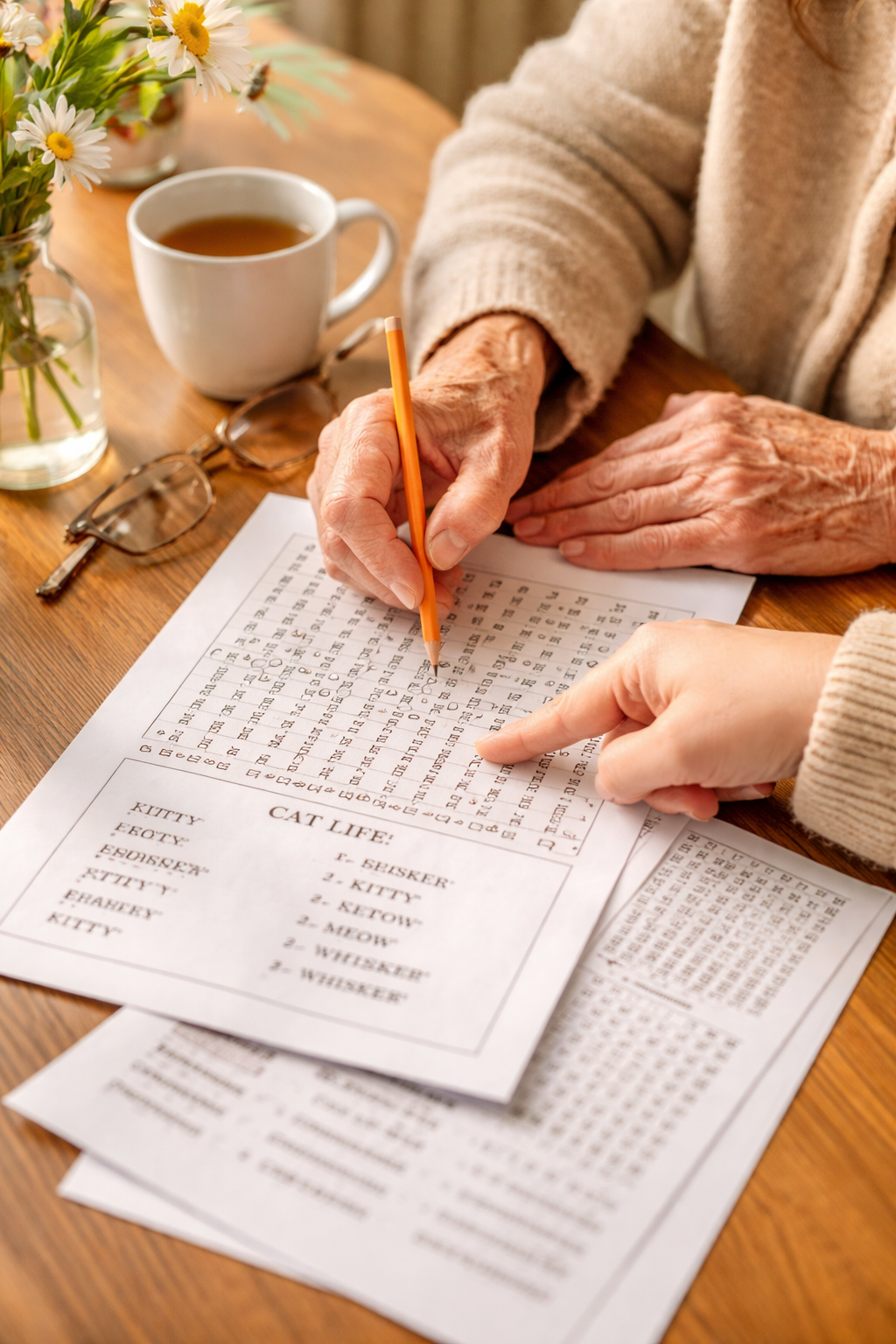
    Free Printable: 1 Word Search Puzzle + Word List + Answer Key (3 pages)

    • Large print
    • Very easy
    • Senior-friendly layout
    • Perfect for a short, gentle activity session

    How to use it (no pressure, just connection):

    • Sit side-by-side and find the first word together
    • Take breaks whenever needed
    • Celebrate tiny wins (“You found it!” goes a long way)
    • If a word brings a memory, follow it gently — and if not, that’s okay too

    Tip: If the person you’re with tires easily, even 5–10 minutes can be “enough.” The goal isn’t finishing — it’s sharing time.


    Turning a worksheet into a small connection ritual

    A few simple ways to make this feel warm and meaningful:

    1. Do it with them, not for them
      “Shall we look for the first one together?”
    2. Invite stories without pushing
      If the theme is animals & pets, you can ask softly:
      “Did you ever have a pet like that?”
      If it doesn’t land, just move on.
    3. Keep the pace slow
      This is not about completing the page. It’s about a calm moment.
    4. Make it cozy
      Tea, soft light, quiet background music — the environment matters.

    If you’d like more: the full Animals & Pets set

    If the freebie feels like a good fit, I also made a full Animals & Pets Word Search set for seniors, designed in the same gentle style — large print, very easy, and caregiver-friendly.

    Full Version includes (60 pages total):

    • 20 word search puzzles
    • 20 matching word lists
    • 20 answer keys (solutions included)
    • Printable PDF in A4 + US Letter

    👉 See the full Animals & Pets Word Search set here:


    A soft reminder for caregivers

    You don’t need a “perfect” activity. You just need something that makes it easier to be together without pressure.

    Sometimes it’s a pencil, a page, and the quiet joy of finding a simple word side by side.


    Please note: This is a digital download. No physical item will be shipped.

  • Caregiver Corner: 10 Easy Large-Print Recipes for Gentle Kitchen Days

    Caregiver Corner: 10 Easy Large-Print Recipes for Gentle Kitchen Days

    Some days, cooking is a joy.
    And some days… cooking is just another thing on a list that already feels too long.

    If you’re a caregiver (or you love someone who needs a bit of extra support), you probably know these “in-between” days. The days when you want something warm and familiar on the table — but you also want the process to feel calm, not complicated.

    I’m in that world too — both through my work and in my family — and I’ve learned something that sounds almost silly, but helps a lot:

    When the day feels heavy, small rituals matter.

    And in the kitchen, a small ritual can look like this:

    • one simple recipe
    • one page you can actually read
    • and a gentle pace that leaves room for conversation (or quiet)

    The problem with most recipes (especially on tired days)

    A lot of recipes are written for people who have:

    • perfect lighting
    • perfect energy
    • and perfect eyesight 😅

    But caregiver days aren’t like that.

    Tiny fonts, cluttered pages, long ingredient lists, “just sauté for 18 minutes while you simultaneously do three other things” — it’s not helping. Sometimes we need recipes that feel like a friendly hand, not a challenge.

    A gentle kitchen routine I use (15–30 minutes, no pressure)

    This is my favorite way to make cooking feel calmer — especially when someone is easily overwhelmed or distracted.

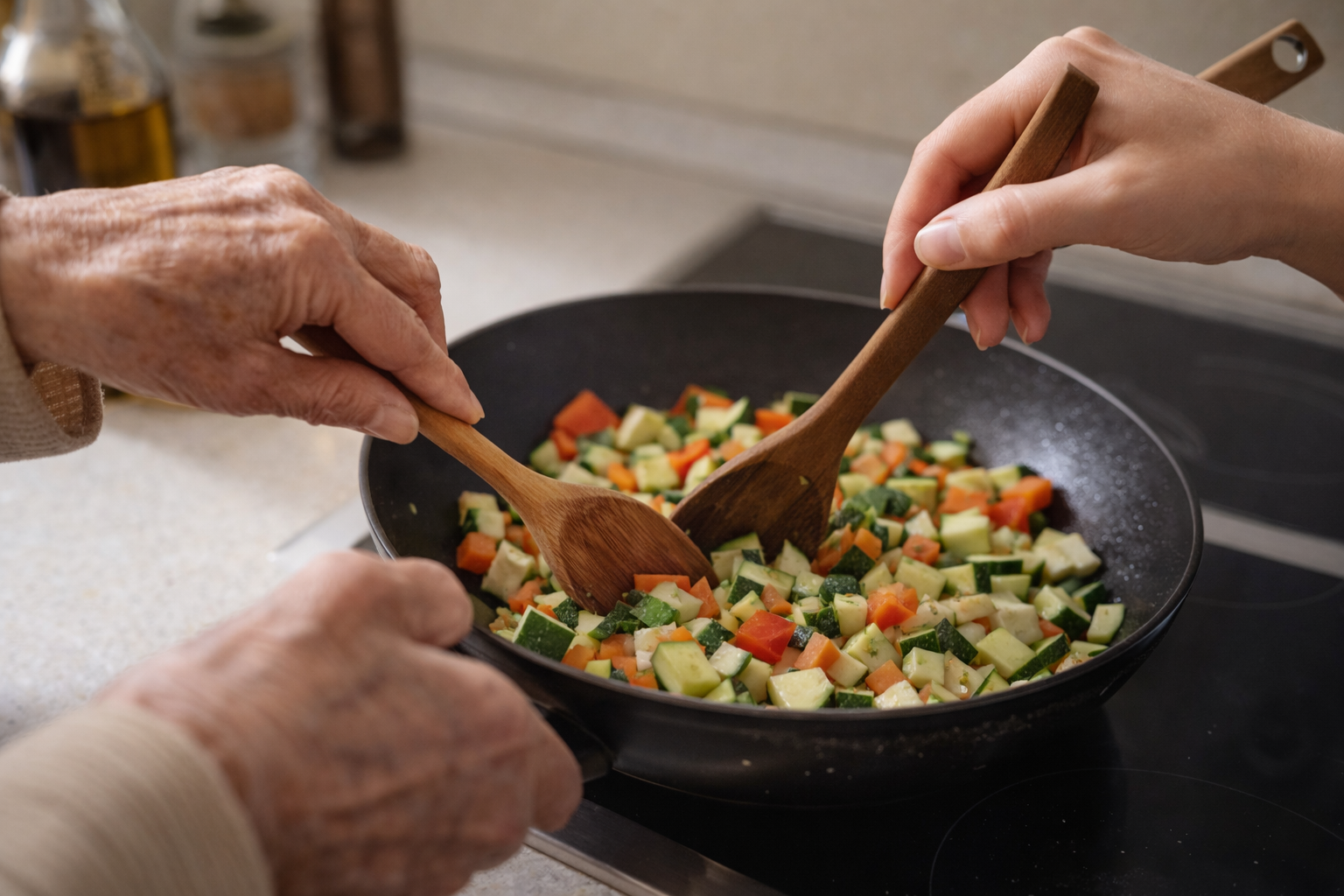
    1) Pick one familiar recipe

    Not a new experiment. Not a 12-step project. Just something simple and recognizable.

    2) Read it out loud (even if it feels weird)

    Reading the steps together slows everything down in a good way. It also turns cooking into a shared moment, not a performance.

    3) Set up like it’s “activity time,” not “work time”

    A cup of tea, a clean surface, a small bowl for scraps, and a gentle start.
    Sometimes just changing the vibe changes everything.

    4) Celebrate the smallest win

    Even if the meal is simple.
    Even if it’s not perfect.
    A warm plate on the table can be a big win.

    Why I made a large-print printable recipe set

    After enough caregiver days, I realized I wanted recipe pages that were:

    • easy to read
    • uncluttered
    • simple enough to follow without stress
    • and printable, so they can live in a folder on the kitchen counter

    So I made a small pack: 10 easy recipes in large print — clean layout, familiar ingredients, and simple steps.

    Want the printable?

    If you’d like the full set, you can find it here:
    👉

    Printing tip: It’s A4. If you print on US Letter, choose “Fit to page.”

    A quick idea: make it a “recipe binder”

    If you have a folder or binder at home, you can turn this into a tiny routine:

    • print the pages
    • add a cover
    • keep it somewhere visible
    • and let it become your “we always have something easy” backup plan

    Future-you will be grateful.

    A gentle note (because caregiver life is real life)

    If today is one of those days where everything feels like effort — you’re not failing. You’re carrying a lot.

    Start small. Make it simple.
    And if all you manage is tea and toast, that still counts as care.

  • A Little Garden Indoors: Gentle Coloring for Caregiver Days

    A Little Garden Indoors: Gentle Coloring for Caregiver Days

    Some seasons are made for muddy boots, fresh air, and “just one more thing” in the garden.
    And some seasons… are made for looking out the window, checking the forecast, and realizing that your garden dreams are still on hold for a while.

    If you’re a caregiver (or you love someone who needs a little extra support), you know those “in-between” seasons well. I’m in that world too — both in my work and in my family — and I’ve learned something simple: when the days feel heavy, small rituals matter.

    So until we can truly get back outside, here’s one gentle way to bring a little spring into the living room:

    a quiet cup of tea + one flower coloring page + 15 minutes of “no pressure.”

    No big setup. No complicated instructions. Just a small win.


    Why flowers work (even when energy doesn’t)

    Garden themes are familiar. They don’t feel childish, but they also don’t demand a lot. Flowers are “safe” conversation starters:

    • “Did you have flowers in your garden?”
    • “What was your favorite season?”
    • “Do you remember the smell of lilacs / roses / lavender?”

    Even if words are hard some days, a simple picture can still invite connection.

    And honestly? Sometimes the win is simply sitting side-by-side, sharing the same page, and letting the moment be enough.


    My tiny “Caregiver Corner” coloring ritual (15 minutes)

    Here’s the routine I keep coming back to:

    1. Set a timer for 10–15 minutes
      Short is good. “We can stop anytime” is even better.
    2. Choose one page only
      One page = one activity. Easy to start, easy to finish.
    3. Pick just 1–3 colors
      No need to plan a masterpiece. One color is still a win.
    4. Let it be messy, imperfect, and relaxing
      The goal is calm — not perfection.

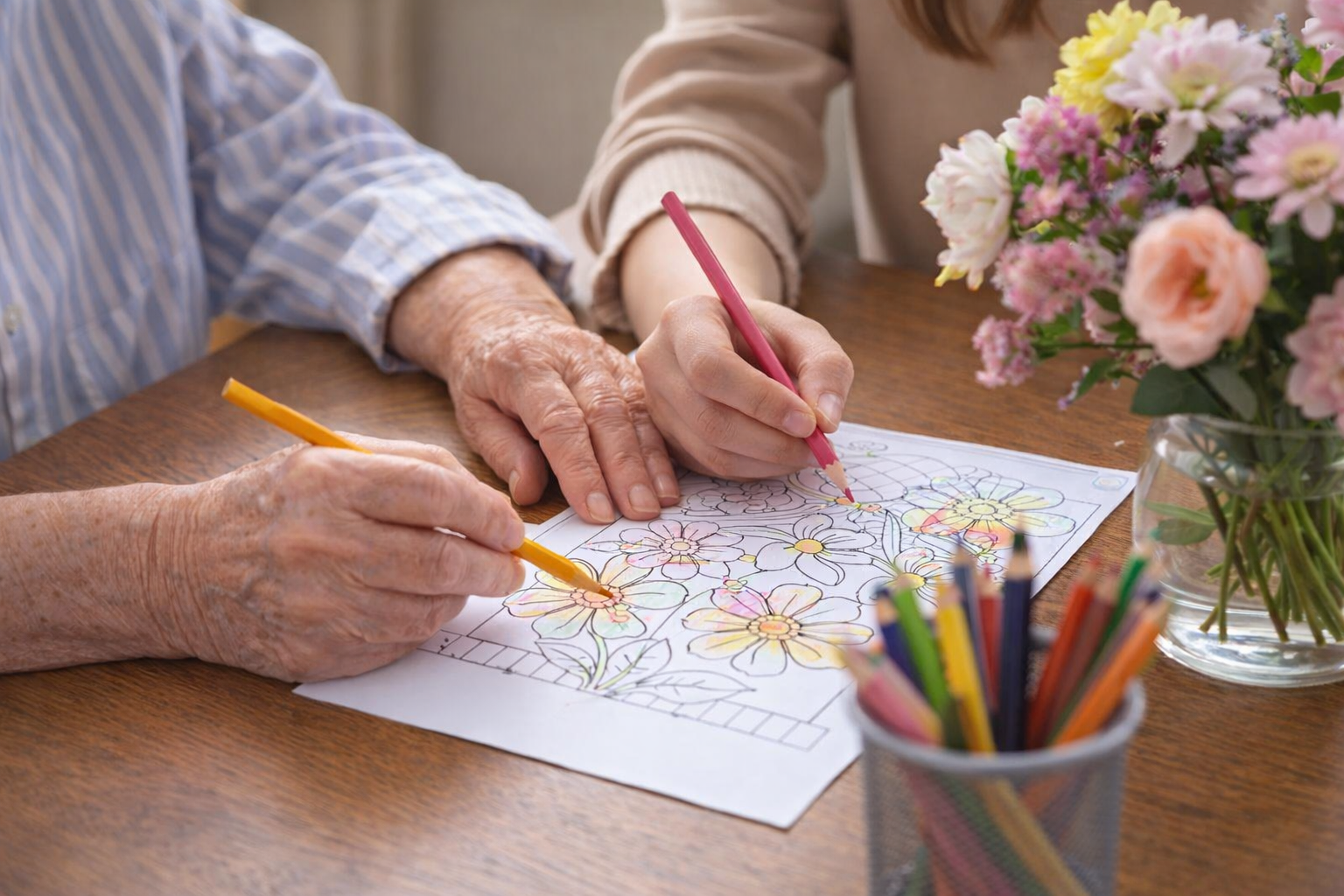
    If you’re doing this with someone else, try coloring one small section together (a petal, a leaf, a corner). It turns the page into a shared moment.


    A couple of printing & comfort tips (that actually help)

    • Bold outlines + lots of white space are easier on tired eyes.
    • Try thicker pencils or markers if gripping is difficult.
    • If you print on US Letter but your file is A4, use “Fit to page.”
    • If markers bleed through, print on slightly thicker paper or test one page first.

    Freebie: 2 gentle flower coloring pages (download)

    I wanted to make it easy to try this ritual right away, so here are two free printable flower coloring pages from my Gentle Garden set:

    Freebie: 2 gentle flower coloring pages (PDF)

    Click the link below to download the clean, printable 2-page PDF (A4). Tip: choose “Fit to page” if you print on US Letter.

    Tip: Save them in a folder called “Caregiver Corner – Quick Wins.” Future you will be grateful.


    Want the full set?

    If you’d like more pages in the same simple, calming style, I also made a printable pack with 20 flower coloring pages (bold outlines, uncluttered layout, black & white for easy printing):

    👉 Gentle Garden Flower Coloring Pages (Printable PDF)

    It’s designed to be quick to use — print one page, enjoy the moment, repeat whenever you need it.


    One last thing (from one caregiver heart to another)

    If today feels like a lot: you’re not failing because you can’t do everything.
    Sometimes care looks like big things… and sometimes it looks like a warm drink and a single flower on paper.

    Either way, it counts.